
A tribute to Ammon Hennacy
Ammon Hennacy was a war resister, pacifist, tax resister, vegetarian and Christian anarchist. He worked closely with the Catholic Worker’s Movement, and was on good terms with its co-founder Dorothy Day.
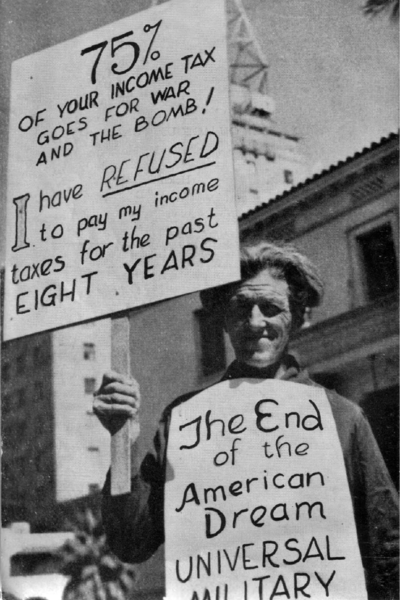
Figure 1. Ammon during one of his protests
Resisting the draft and imprisonment
For resisting the draft in World War 1 Ammon spent approximately two years in prison — approximately eight months of which were spent in solitary confinement. While he was there he had his conversion to Christian anarchism. This conversion was probably inspired by the writings of Leo Tolstoy, on the one hand, and his meeting with anarchist Alexander Berkman whom he met while in prison on the other. (Prior to that Ammon had been involved with socialist or communist groups.)
Ironically, a lawyer who wanted to keep Ammon in prison for resisting the draft referred to him as a ‘coward’. Even a cursory knowledge of Ammon’s life and character shows that the opposite was true; he was perhaps one of the bravest people of the twentieth century. It’s peculiar that his person and legacy are not more widely known; and this short article is a modest attempt to change that.
Tax resistance and fasting
As a protest against Government spending on war Ammon fasted for days — sometimes even weeks — at a time. Many of his fast days were spent holding a placard outside Government buildings in an effort to bring his message to a wider audience.
Aside from his fasting, he practiced income tax resistance over a long period. He even left a well-paying Government job as a social worker in order that his income could not be taxed at source, and spent several years in ‘stoop labour’ — i.e. as a manual farm labourer.
If that were not enough in itself, he sent a letter to the Revenue Commissioners for several consecutive years — just before income tax due date — outlining precisely how much he had earned, as well as his reasons for refusing to pay income tax. These letters are a very strong testament to his intellect and character and can be read in his autobiography.
His person
Some might have accused him of being arrogant, stubborn, and pig-headed. He sometimes referred to people who retreated in the face of potential run-ins with the law as ‘pipsqueaks’, for example. Some would argue he was going too far in that. At the same time, when you consider the state of society today — and the potential consequences of wide-scale cowardice — maybe his criticism is partly warranted. In any case, it is abundantly clear from his auto-biography that he was a man of good nature (and humour) as well.
‘Worse than a communist’
Some people who met him protesting accused him of being a ‘communist’. This may have been around the time of the McCarthy era, so this was a label that many people scrupulously avoided. Ammon, however, responded in good humour that he was ‘even worse than that’; he was an anarchist.
Spirituality
He briefly converted to Catholicism in later life, but later disassociated himself from the church. It may be for this reason that his autobiography was renamed from ‘The Autobiography of a Catholic Anarchist’ to ‘The Book of Ammon’.
He mentioned at one point feeling a closer attachment to the spirituality of Native Indian tribes than to institutional Christianity. He also made good friends with people in the Hopi tribe; and spent a lot of time with them.
Joe Hill House of Hospitality
In his latter years he established the Joe Hill House of Hospitality — providing food and shelter for the homeless. In doing this he practiced his philosophy of helping people directly — rather than via taxation and Government.
His legacy
I don’t necessarily agree with his point of view on certain matters; but I’m not going to nit-pick and criticize him either. The man was a moral giant; there are few people alive today I can think of who come close to him in his level of courage or his moral standards. If the broader population — even a small portion of it — had his courage and authenticity, society would be very different (in a positive sense). But part of his message was that we shouldn’t wait for that to happen. We should do what we can even if we are doing it alone.
To read more about Ammon’s life and views see this Wikipedia article: https://en.wikipedia.org/wiki/Ammon_Hennacy . If you have time, check out his autobiography: https://archive.org/details/bookofammon0000ammo . Be prepared to allocate time to read it; it’s pretty long. But — even if you only read a small fraction — it might just change your outlook on life; it did for me.
Comments
No comments yet.