The UN 2030 Agenda is a plan of action for people, the planet and prosperity. The plan sets out 17 Sustainable Development Goals (SDGs) that integrate the three indivisible dimensions of sustainable development - economic, social and environmental. ... The following section sets out 8 Strategic Outcomes which incorporate the overarching objectives of the 17 Sustainable Development Goals of the United Nations’ 2030 Agenda for Sustainable Development, The National Strategic Outcomes as set out in the National Planning Framework and the Regional Strategic Outcomes of the Southern Regions Regional Spatial and Economic Strategy.
Ireland and the Housing Crisis
This article is a follow-up to my leaflets on housing and to my earlier articles on this topic. This is a long-form article — probably my longest yet. There are many facets to this problem (some of which are downplayed or completely ignored by most ‘activists’), and I wanted to touch on all of them.
Most of what is said in this article or presentation certainly applies to other countries. Predatory landlordism, as a phenomenon, is hardly unique to Ireland, and land-use policies which render usable land unusable and inaccessible are being placed in to effect in all countries which have adopted the UN’s sustainable development goals (SDGs).
Having said that, as someone born and raised and living in Ireland I am most keenly aware of — and most qualified to speak on — the facets of these problems as they arise in Irish society. So — while bearing in mind that bodies such as the UN are pushing to implement the SDGs, and the land-use policies that support them, globally — this article will be focused on housing and land-use in Ireland.
Sustainable Development Goals (SDGs)
As implified above, the land-use policies put forth in various development plans throughout Ireland (whether at a national or regional or county level) are being justified largely on the basis that they are stepping stones in the implementation of certain ‘sustainable development goals’ (hereafter referred to as SDGs). For this reason, although the SDGs are not the primary focus of this article, it is important to examine them briefly.
There are 17 SDGs in total. They are listed on the UN website. Those perhaps most relevant to land-use policy are:
-
SDG 11 - ‘Sustainable Cities and Communities’
-
which warns against ‘rapid urbanization’ and ‘urban sprawl’
-
-
SDG 13 - ‘Climate Action’
-
which takes as ‘fact’ that CO2 is a pollutant and that anthropogenic (human-caused) CO2 emissions are responsible for (dangerous) climate change — and that we must adapt our travel patterns and way of life accordingly
-
-
SDG 15 - ‘Life on Land’
-
which frames human presence and habitation as a menace to and destructive towards wildlife systems and biodiversity.
-
A common takeaway from these goals and the philosophy which underlies them is that humans are a burden upon and threat towards our natural environment and our countryside. Accordingly, the SDG authors urge all parties involved in environmental and societal planning — at all levels — to concentrate human populations in well-defined settlement areas.
The Waterford City & Council Development Plan
The Irish political class, unsurprisingly, has embraced the SDGs with unwavering support and enthusiasm. Ireland as a nation become a formal signatory to the UN Sustainable Development Goals some time around 2015. And support for the SDGs is clearly acknowledged in the Waterford City & County Development Plan 2022-2028 (WCCDP). To quote from Volume 1 Chapter 1 of this plan:
Environment threats — real and imagined
Speaking very broadly, environmentalists typically identify four classes of potential threats to wildlife and the environment — most of which are genuinely harmful and problematic (at least potentially), but one which is far more controversial. These are:
-
air and water pollution
-
the threat to biodiversity and animal habitats posed by ‘urban sprawl’ and rural development
-
(this is what many ‘conservationists’ are concerned about, for example)
-
-
improper handling or disposal of non-biodegradable waste (e.g. plastics), which — aside from posing an eyesore and potentially endangering human health — exacerbates threats 1 and 2
-
CO2 emissions
The environmental issues and concerns raised in the WCCDP broadly reflect this list, and it places enormous emphasis on CO2 emissions and ‘climate action’.
This author shares most of the environmentalists' concerns, and acknowledges threats 1 and 3 in the list above. The author tentatively acknowledges threat 2 also — in that thoughtless building and development in ‘ecologically sensitive’ areas is problematic. This acknowledgement, however, is a far cry from endorsing a blanket ban on home-building in rural areas or implying that every structure erected to nurture and sustain human life should be subject to the obtuse and heartless planning approval process set forth in our local development plan (which presupposes, entirely incorrectly in my view, that human habitation is automatically a burden upon or threat towards the natural environment).
Even more dangerous than their assumptions about the human threat to biodiversity is their promotion of the belief that CO2 is a ‘pollutant’, and that human-caused CO2 emissions are responsible for irreversible climate change. The reason that this is so significant — and potentially dangerous — is as follows. Every decision regarding where homes are built in this country, and whether or not a ‘one-off build’ is allowed in a rural area, is made based on a local development plan, which in turn reflects higher-level policies and objectives set forth in regional and national development plans and frameworks — such as the National Development Plan. All of these policies and objectives — every single decision regarding zoning and land use made by various authorities throughout the country — is based (at least partly) on the belief that our CO2 emissions are causing (potentially irreversible and dramatic) harm to the earth’s climate. So — as peculiar as this may seem — it is potentially in our interest (potentially very much so) to investigate and examine this claim.
Before you call someone a climate denier …
Before you call me (or anyone else) a ‘climate denier’ please be aware of the following points.
-
Climate skeptics don’t ‘deny’ that the climate is changing; they dispute that human-caused CO2 emissions have a significant adverse effect on the climate.
-
CO2 constitutes only .04% (400 parts per million) of our atmosphere and is not the only ‘greenhouse gas’
-
Water vapour is a very significant greenhouse gas and is present at much higher concentrations than CO2
-
-
There is controversy and uncertainty regarding how long CO2 remains in the atmosphere (its ‘residency time’), and some observers are concerned that IPCC authors have greatly overestimated this duration.
-
Various warnings and apocalpytic scenarios put forward by climate alarmists — such as that ‘we have X number of years to save the planet’, or ‘such a coastal area will be under water by year X due to sea-level rise’, etc. — have repeatedly been found to be baseless.
-
See this page for a long list of failed predictions.
-
-
CO2 is plant food
-
Greenhouse-owners sometimes intentionally increase the concentration of CO2 in their greenhouses to increase their yield
-
-
The infamous ‘hocky-stick graph’ prepared by Michael Mann and used by Al Gore in his alarmist and fear-mongering presentations — which implied that the earth’s temperature dramatically increased towards the end of the twentieth century — used highly dubious and highly selective data analysis and statistical methods.
-
Mann’s methods have been roundly criticised — indeed, condemned — by various statisticians and scientists.
-
-
Evidence indicates that the CO2 concentration in earth’s atmosphere has been much higher at various stages in the ancient past — as high as several thousand ppm compared to approx. 400 ppm today — and yet no ‘runaway warming’ event was ever triggered.
Lastly, if you have time, please read about the ClimateGate scandal. James Delingpole’s book, WaterMelons, provides clear insight in to this; and there is no shortage of other information about the scandal available online.
|
Although I am open to comments, criticism or corrections made in good faith, if anyone sends a comment or e-mail calling me a ‘climate denier’, I reserve the right to delete said e-mail and block the correspondent’s email. |
|
Aside — climate skeptics who downplay genuine environmental concerns
I have noticed that some — though not all — climate skeptics downplay or trivialize genuine environmental threats and problems, such as plastic waste and pollution. From my perspective this significantly undermines their credibility. We need to wholeheartedly acknowledge genuine environmental issues and develop and maintain reverence for our natural environment, while at the same time examining the motives of those who promote fear about CO2 emissions and placing their claims under scrutiny. |
Landlordism
The other aspect of the housing crisis which I want to discuss is landlordism. While many people are pointing the finger at immigrants and blaming the housing crisis on mass immigration, this deflects attention away from landlords. This suits the landlords, no doubt, who are all too happy to be excused from public scrutiny and for people to ignore that they have significant culpability for the widespread suffering in our country due to a dearth of affordable homes.
I want to be careful with words here and qualify the above statement. As I stated in one of my leaflets on the housing crisis, I don’t want to tarnish all landlords with the same brush, and I’m not implying that all landlords bear culpability for the current crisis. I’m not implying that owning more than one home or building and renting out the spare space is automatically immoral. Landlords may come in to possession of their properties by a variety of means — some of which involve no harm (direct or indirect) to other people — and, e.g., ask for rent only to help them recoup their initial outlay and the costs of repair and maintenance. These people (especially when we are only talking 2-3 properties in total — including their own home) are hardly responsible for the housing crisis.
There are another class of landlords, however, who have a different mindset. These are the people who view homes purely as a source of income and acquire them not to live in but solely for the purpose of renting them to others. These people do share culpability for the current housing crisis. These people don’t deserve our admiration or esteem, and we shouldn’t exonerate them from the suffering they cause by saying that the housing shortage is all due to immigrants.
The important of access to land
In the land agitations in Ireland in the 19th century people had a different attitude to land and housing than most people do in the present day — in a sense that I will try to explain. Preeminent in those struggles — as led by Michael Davitt of the Land League, for example — was access to land. Although there are similarities in the campaigns of certain groups today who work on behalf of tenants, the homeless, and people in precarious housing situations and the Land League and other land activists in the 1800s, there is a vital difference as well.
Present-day activists for housing often (perhaps not always but typically) claim that housing is a ‘right’; and that the Government has a responsibility to provide it for everyone who needs it. Land activists in the 19th century, on the other hand, made no such claim. They (at least to my knowledge) never asserted that people have a ‘right to housing’; and certainly didn’t propose (or perhaps even imagine) that it was the responsibility of others to ‘provide’ them with houses. What people had a ‘right’ to — what was sacrosanct — was land. And, just as every able-bodied individual has the wherewithal to place one brick on top of another and haul a tarpaulin over their heads to protect themselves from the elements, access to land (in their minds) more-or-less implied access to shelter, since — settings aside present-day planning regulations — anyone with access to land and a modicum of intelligence who needs shelter will waste no time in building it. (The fact that some readers might find this idea ‘odd’ or even outlandish indicates just how emasculated and dependent on the state the present-day generation is.)
I realize the above remarks might seem obnoxious, or even callous. Emphasising access to land as paramount is all well and good, one might say, but what about people such as the disabled and elderly who are unable to build their own homes and shelter? What about them? My answer — in two words — is mutual aid. Insisting that people have a ‘right’ to our assistance does not improve matters one iota; it only makes them worse. Inventing such ‘rights’ only allows bureaucrats and ideologues (many or most of whom have only a vague comprehension of what is required to actually fulfill such imaginary rights — because they have never done an honest day’s work in their life) to insinuate themselves within and interfere in other people’s lives — and never to good effect.
Going back to the Land League …
In his later life, Michael Davitt (one of the League’s founders) expressed support for Henry George’s ideas on land use. Henry George (an American) — who proposed a Land Value Tax or ‘Single Tax’ — himself followed the struggles for land justice in Ireland with keen interest. To offer a crude summary of George’s ideas, he (rightly) condemned the grossly unequal access to land which was (and still is) a more-or-less universal feature of Western ‘civilized’ nations, and identified it as the primary cause of economic recessions and even societal ills more generally. He proposed taxation — a ‘single tax’ (on land) — as the solution. He explained his ideas at length and in detail in his book Progress and Poverty. Personally, I am skeptical that this — or, indeed, anything involving taxation — is a long-term solution to the land problem. I mention it because a lot of people who consider it (including Davitt himself) seem to be seduced by George’s ideas.
Mass immigration
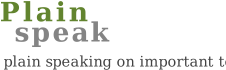
The sanctioning, encouragement and support of mass immigration in to Ireland by the Irish political powers and NGOs over the past two decades was clearly instigated — at least in part — to undermine native Irish culture and stir up racial and ethnic tensions. The inevitable response — of concerned natives taking to the streets bearing placards stating ‘Ireland for the Irish’ and ‘Irish lives matter’ — fuels the narrative of ‘far-right racists and extremists’ at large and unchecked.
As an anarchist, I have no problem (at all) with natural immigration. But what’s happening in Ireland (indeed, throughout Europe) currently is clearly not ‘natural’; it is the opposite.
This is not natural migration
Some people, naively and carelessly, might draw a comparison between immigration in Ireland currently, and the migration of large numbers of Irish to America in the 1800s. Trying to bypass people’s center of reason and appeal to the emotion, they might say: ‘Think of how many of our own Irish people emigrated to America during the Great Famine, and how they were welcomed there. It is our moral duty now to welcome those from less fortunate regions.’ But this is a very tenuous comparison and can’t really be taken seriously for a number of reasons.
Firstly, the Irish emigrating to America during the 1800s was what I refer to above as natural migration; the emigrants weren’t lured there by Government incentives nor supported, while there, by American taxpayers. There wasn’t a network of NGOs which promoted and looked out for their (the emigrants') interests, while simultaneously denigrating the interests of native and settled Americans — and certainly no network of NGO-allied ‘activists’ to gaslight and portray as ‘racist’ any non-emigrants who dared to suggest that their own needs and well-being were just as important as those of the newcomers.
Secondly, there wasn’t already an acute housing crisis in America at that time as there is in Ireland today. Need any more be said on this point?
Thirdly, there is no unoccupied ‘frontier land’ in Ireland in 2026 as there might have been in 19th-century America. Even though, from a superficial analysis, Ireland’s population density might not seem high compared to certain countries, this is completely misleading. As I touched on above — and as I explained in my leaflet on this issue — the land-use policies in effect in our country dramatically increase the contention for land, and the effective population density is much higher. (A huge amount of land is simply ‘off limits’.) There is simply nowhere for people to go.
If the land-use policies were rescinded, and what we had before us was a natural immigration phenomenon rather than a socially-engineered one, than we could put our imagination to the task; we could cope. We could extend the ‘Irish welcome’. But the present policies make this effectively impossible; and the anger and outrage of Irish natives is completely understandable.
Double standards
Think of the absurdity of this, for example: a building developer who is awarded a tender to build a center for IPAs (International Protection Applicants) in a rural area is more-or-less allowed to bypass the usual planning approval procedures that local people need to go through — or at least has their approval ‘fast-tracked’. Local objections or protests, in this case, typically account for nought. But if a local individual takes the initiative to build a log cabin on land which they legally own (rather than waiting for the state or council authorities to provide housing for them), they are threatened with imprisonment.
If our policy makers were truly earnest in their concern for the environment, the planning approval for such IPA centres would be subject to as rigorous a biodiversity impact assessment as any other planning application — especially considering that these buildings tend to be much larger than and require more supporting infrastructure than, e.g., a one-off family home or even a cluster of such homes.
Evidently, however, such considerations — along with wider environmental concerns and all talk about ‘sustainable development’ — are thrown out the window when it suits them. Our policy makers grant themselves enormous leeway — sufficient to break their own rules and ignore their own guidelines when the need arises. But most people who need a home (which includes, well, pretty much everyone else) have no such leeway. A typical Irish couple — e.g. in their twenties or thirties — might dream of building their own home — using natural building techniques and without ‘breaking the bank’. Due to the way in which land is zoned, however, very, very few people actually succeed in doing this. Most people, instead, end up in one of the following situations:
-
renting and at the mercy of landlords;
-
taking out a mortgage from a predatory lending institution (which ends up being far more expensive — and stressful, and dangerous — than the afore-mentioned approach to a ‘self-build’);
-
living with their parents (if they are fortunate enough to have that option); or
-
living in subsidized housing — which many people don’t want because they are then partly dependent on or beholden to the same Government which — to a large extent — is actually responsible for the housing crisis in the first place.
Is mass immigration responsible for the housing crisis though?
Getting back to the issue of mass immigration …
Despite my misgivings mentioned above, I still don’t think it is appropriate or fair to attribute the housing crisis to this cause. From my perspective, the primary causes are 1. the land-use policies pursued in trying to implement the SDGs, and 2. predatory landlordism. (Speculation in land values — people buying and selling large tracts of land for purely financial gain — is a related topic which I don’t have time to discuss here.) The Government’s policy of mass immigration in the last decade or so — while perhaps not the main factor in the crisis — is adding insult to injury — like rubbing salt in open wounds.
No ‘political’ solution in the long term
Contrary to the opinion of many people, I do not accept that the proper or moral solution to the housing crisis — long-term — is more Government spending on social housing. As I have taken pains to try to explain here (and in previous articles) the acute shortage of affordable homes and the associated contention for land is a direct and inevitable consequence of land-use and ‘environmental’ policies that this same Government signed off on and put in to effect.
|
No faith in any political party
Fine Gael, Fianna Fáil, Sinn Féin, Labour, the Social Democrats, etc.
Please don’t waste my time or insult my intelligence by trying to excuse any of these parties or implying that one or the other is not ‘compromised’.
|
Why would you petition the same people who caused a problem and are largely responsible for the ongoing suffering of thousands of people to fix it for you — especially when they steadfastly refuse to even acknowledge the problem or their role in it? People who question the logic and sanity of ‘climate action’ plans and the ensuant land-use policies, for example, are branded as ‘climate deniers’ and ‘anti-science’. (If you still don’t understand how this issue ties in and relates to local development plans and zoning and housing availability then please go back and read the sections above on the SDGs and (real vs. imaginary) environmental threats.)
The Government’s relationship with its electorate — with the people of our country as a whole — is that of a narcissistic abuser; of an intelligent bully who convinces his victim that his blows and insults are actually ‘in his (the victim’s) best interest’ — all while the ritual abuse continues. Asking the Government to ‘solve the housing crisis’ for us is like asking a violent perpetrator to supply you with bandages to treat the very wounds they’ve inflicted — and all while they are continuing to beat and assault you.
We don’t — in the medium and long term — need the Government to ‘help’ us. We need to protect ourselves from it — and alleviate the enormous damage that its policies and regulations have caused to our way of life and living standards.
Lastly, as I mentioned in passing above: I am basically an anarchist. Most people don’t understand what that term means. I use it simply to mean ‘against all forms of domination’ — which includes Government as that term is commonly understood. So please don’t send me emails or try to convince me that we just need to get the right political party in to the Dáil, or that some new-found nationalist party are a different breed and will turn things around. Such new political candidates might be a sight better than the current occupants of Leinster House (which wouldn’t be hard); they might even do a lot to partially alleviate the housing shortage. But in other respects they might be even worse than our current Government; and in any case I haven’t come across a single public figure involved in Irish politics who fully understands the scope of the housing problem. And even if they did, why should we place our faith solely in them and wait for them to wrestle with the issue single-handedly?
What can we do?
It is more expedient, from my view, to consider what we can do ourselves. I think, as one of the first priorities, we need to examine the justification for the land-use policies put forth in local development plans — namely:
-
protection of biodiversity and the natural environment (which is largely valid but is being taken to far too great an extreme); and
-
curbing CO2 emissions to ‘combat climate change’ (which is extremely dubious).
If, on examining the relevant evidence (e.g. regarding climate change), we learn that these policies are not justified, then we should repudiate them. That, of course, risks placing us directly at loggerheads with policymakers, planners and even law enforcement, so we should acknowledge that possibility and to the extent possible be prepared for it.
As unattractive and uncomfortable as that prospect might seem, bear in mind the reality of the current housing crisis and the possible alternatives:
-
homelessness,
-
a precarious lifteime of renting and never being secure in your residence;
-
placing yourself at the mercy of predatory financial institutions (if you’re fortunate enough to be approved for a mortgage); or
-
being dependent on Government assistance your entire life (and I don’t mean to criticize anyone who is dependent on such assistance).
Even if you are content with these options, maybe spare a thought for the next generation: they might not be. And they might frown at your complacency and inaction.
Comments
No comments yet.