

Why there is an Irish Land Question
Table of Contents
About the book
In 1880 Mr. Tim Healy — a member of the Irish National Land League (and later a barrister and politician) — wrote a short book which not only outlined the immediate events leading to the development of the Land League, but also gave a valuable and concise summary of the ‘land war’ in Ireland (at least from the time of Queen Elizabeth on). The book was entitled ‘Why there is an Irish Land Question and an Irish Land League’.
Figure 1. Author Tim Healy circa 1900
There is a digital copy of this book available online, but (being a scanned copy of an old document) it is a little difficult to read; so I took the time to edit it and produce a new copy. (The book is out of copyright, so there are no obstacles to doing this.)
Mr. Healy wrote this book when he was only approx. 25 years of age.
In this article, aside from sharing and drawing people’s attention to the book, I want to explain why I think this topic is so important.
Book downloads
The book is available in PDF and EPUB format. You can access the PDF version by clicking on the title page image below. The EPUB version is available here. It is suggested to use the EPUB version on small-screen devices such as mobile phones.
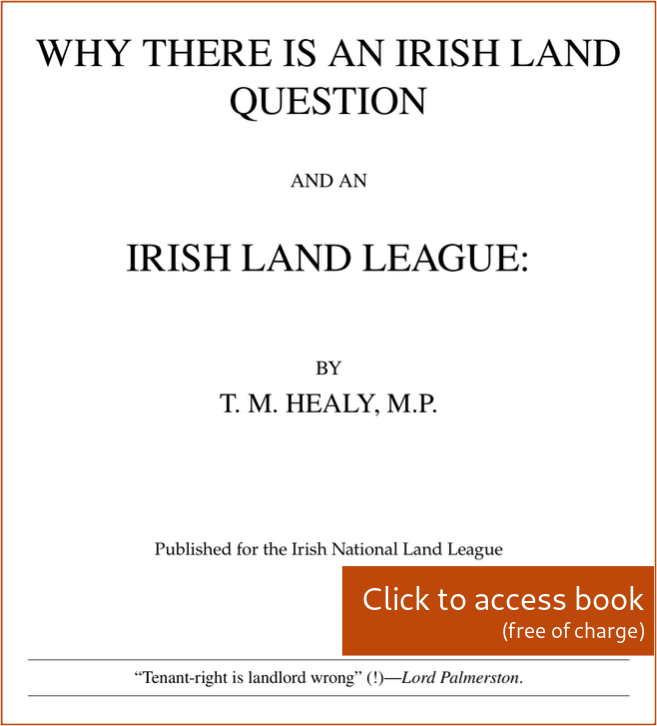
Figure 2. Revised book — front page
The Land War in Ireland
My motiviation in examining the land struggle in Ireland and the suffering of the Irish people at the hands of landlords is not to encourage people to feel sorry for themselves or to encourage a ‘poor me’ complex. It is to point out, to begin with, that many Irish people are still suffering in the present day for lack of land, lack of housing or stable tenure or occupancy; and that the history of land struggles in Ireland is deeply relevant to this situation.
It is to point out that, in a real sense, the struggle for land — the ‘Land War’ as some have termed it — is not really over. It is to point out that, although the landlords may have changed over time, the country is in a sense still ‘occupied’.
Why examine the ‘land question’?
I also invite people to look at the housing crisis from a different perspective. Many people are of the mind that the ‘solution’ to the housing crisis is for the Government and County Councils to manage everything related to housing — where houses are built, how many, what building materials are used, how many rooms they have and how many people are allowed to live there, etc.
I have been skeptical of this view for some time. The problem is not — and never has been — that people are not able to build their own homes or that they lack the wherewithal to cooperate with like-minded people in their vicinity for that purpose (which is what advocates of Government control and more-or-less takeover of house construction are implying). The problem is that either 1. people don’t have any land to build on; or 2. they ‘have’ land but are directly prohibited from building on it (by the same policymakers who purport to be ‘concerned’ about the ‘housing situation’.)
There is also a third scenario — related to both of these: many people who could reasonably afford land for the purpose of building a home are prohibited from doing so — e.g. by zoning and land-use policies, by local housing needs criteria, the prohibitive costs of ‘environmental assessments’, or other red tape. I have written about these issues in other articles.
One can reasonably ask: if policymakers who determine policies regarding land use and housing are so determined to see the housing problem ‘solved’, why do they put so many obstacles in the way of people who have the competence and understanding to solve it themselves? Bureaucrats generally think they know better; in many cases, as in this, they are (at least in some respects) deluded.
There is still an Irish Land question
While the efforts of the Land League were successful in one sense (e.g. in the development of the Land Commission) I don’t think that success was complete. Or, at least, a related question — again related to land and land-use — has arisen. And approximately 145 years after T.M. Healy wrote this short book, I would say that there is still an Irish land question.
To anyone who is legitimately concerned about the housing situation but who at the same time has even a slight inkling or gut-feeling that the solution proposed by Ireland’s political left (i.e. Government control of housing construction and supply) is not all it’s cracked up to be: you could do a lot worse than to read this book — even just a chapter or two. Perhaps then, like me, you might be of the mind that we should seek out other ways to solve this problem.
Not underestimating the scope of the problem
This is a massive and complex issue, with many nuances. I certainly don’t claim to have all the answers. But it seems to me that Irish politicians don’t have the answers either, and in fact aren’t even asking the right questions.
In any case, this short book will help readers to understand the history of the struggle for land in Ireland. And I believe this is vital, because — although the nature of that struggle is in certain ways different to how it was in the 18th or 19th century — it is still present; and (although, bewilderingly, very few people highlight this) understanding this history, or at least the fundamentally problematic nature of the landlord-tenant relationship, is essential to understanding the current housing crisis.
Comments
No comments yet.